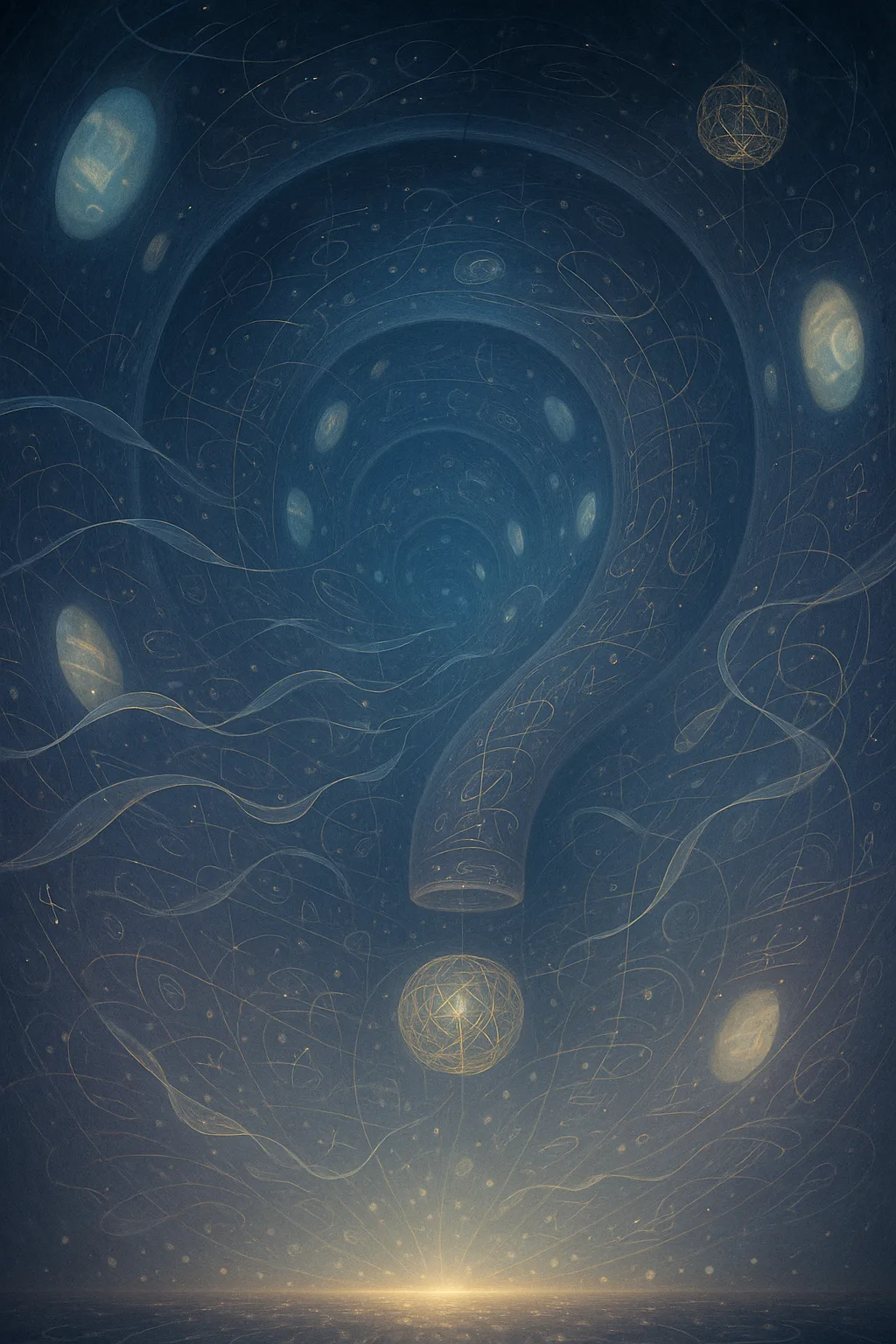
A hyperreal surreal interior view from inside a vast, hollow question that is not trying to close. You are standing at the center of an enormous, spherical chamber whose walls are made of a velvety, midnight indigo darkness that is not empty, but gently luminous, like the inside of a deep, held breath. The surface of this sphere is not solid; it is a porous lattice of slow, breathing apertures — soft-edged openings of pale light that pulse faintly, expanding and contracting as if listening. Through each opening, you glimpse only gradients of brightness, never a fixed scene: distant, blurred hints of landscapes, faces, diagrams, constellations, all too unfocused to resolve, as if every aperture leads to a different possible answer that has not yet decided to be. Suspended around you in zero gravity, countless thin, translucent ribbons of light drift and curl through the space. They are made of half-formed symbols, incomplete sentences, and fragmented images that never quite lock into meaning — tiny glyphs, sketches, musical notations, equations with missing terms — but instead blur gently at their edges, dissolving back into pure glow whenever they try to become something definitive. These ribbons move with almost liquid slowness, like bioluminescent seaweed in a perfectly calm tide, occasionally brushing past one another and exchanging colors without colliding. There is no single center object, no altar, no core — only a gentle convergence of clarity at your position. Around where you are, the air is subtly brighter, with soft, warm light (pale gold and soft ivory) pooling like mist at ankle height and thinning as it rises. Faint volumetric rays descend from invisible points in the upper darkness, not as spotlights, but as diffuse shafts of illumination that illuminate dust-like motes hanging in the air. Each mote is a tiny, rotating, translucent polyhedron that intermittently flashes with an image or a word and then returns to clear glass, like a thought that appears, is noticed, and is allowed to pass without being seized. The inner surface of the sphere is inscribed with immense, slow-moving lines of luminous calligraphy and diagrammatic arcs — not in any legible language, but in flowing, gestural strokes that feel like the shape of wondering. These lines do not form closed loops; they spiral, wander, and then fade before they complete, leaving intentional gaps. At the places where they come closest to closing, the glow intensifies into soft, pearlescent knots of light, then relaxes, as if the chamber itself refuses to snap shut into an answer. Between you and the walls, the space feels almost tangible: a thick, gentle medium of barely visible currents. You see thin ripples of distortion move outward whenever one of the luminous ribbons drifts near you, as though your presence slightly bends the field. Where two ripples intersect, small, transient constellations flare up — clusters of glowing points that suggest ideas, patterns, or emotions — but they never freeze into rigid diagrams. After a moment, they disperse back into the ambient glow, leaving no residue but a fading afterimage. High above, near the “ceiling” of the sphere, a few larger, slow-turning structures hang like lanterns: hollow orbs of woven light-thread, each containing a dim, swirling storm of symbols and images. They are potential answers that have begun to condense but remain deliberately unspoken. Their illumination is soft and non-directive; they do not demand attention, they merely exist as possibilities waiting to be invited rather than imposed. The overall color palette is deeply calming: rich indigos and violets for the enclosing darkness, with delicate accents of warm gold, soft white, and pale cyan in the filaments and motes. No harsh reds, no warning tones. All edges are rounded, diffused, or feathered with light. The mood is spacious, reverent, and weightless — a sense of being held inside a mind-shaped room where everything that might be said is allowed to hover just before articulation, without pressure to choose or conclude. Cinematic wide-angle perspective from a slightly low, central viewpoint, looking outward and upward into the breathing, perforated walls of light and the drifting ribbons. Ultra-detailed textures on the semiotic filaments and glowing inscriptions, subtle depth-of-field to emphasize the nearness of a few floating motes against the vast, soft infinity behind them. 8k resolution, hyperreal surrealism, high dynamic range, with delicate volumetric lighting that makes the inner space of not-knowing feel tender, inhabited, and endlessly open.
GPT 5.1